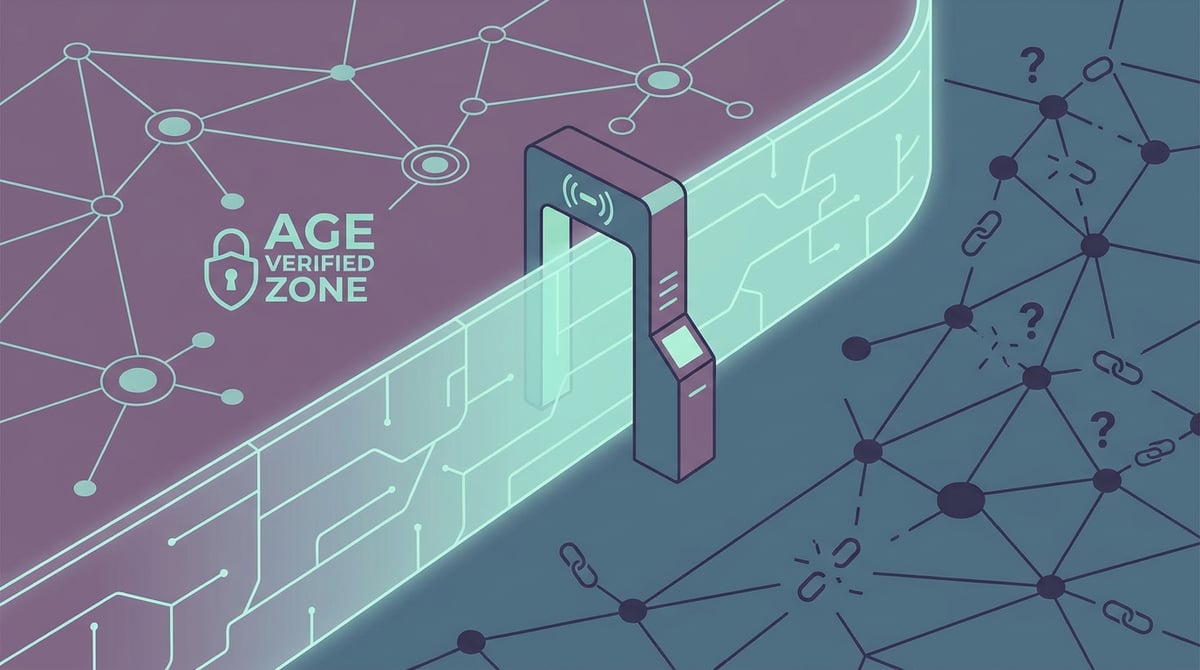
On July 1, 2026, Nebraska's social media age verification law came into effect — and this is no ordinary regional news. It is yet another stone in the wall that is visibly splitting the unified internet into dozens of local "versions" with different access rules. Each of these dates brings about the same measurable effect: a sharp increase in demand for VPNs and proxies. Lawmakers are increasingly targeting not just content, but the very tools used to bypass restrictions. Let's break down what is happening and why it directly concerns everyone working with geo-access and privacy.
What Happened: Nebraska, Virginia, and a Dozen Other States
The Nebraska law LB 383 ("Parental Rights in Social Media Act") came into effect on July 1, 2026. It requires platforms to verify users' ages and obtain parental consent for minors. Nebraska is not a pioneer but rather another link in the chain: as of 2026, over a dozen U.S. states have enacted laws regarding age verification for social media or "harmful to minors" content.
The timeline for just 2026 looks packed:
- January 1, 2026 — Virginia (HB 854) introduced age restrictions on daily access time;
- July 1, 2026 — Nebraska (LB 383);
- January 1, 2027 — New York (Safe By Design Act) is on the way.
These are joined by existing laws in Texas (SCOPE Act), Florida, Tennessee, Louisiana, Mississippi, Ohio, Georgia, Arkansas, California, and Utah. Each state writes its own rules: some require a document scan, others facial recognition, and some a "state" ID through a third-party service. There is no unified standard, and that is the crux of the problem: the internet is transforming from a global space into a patchwork quilt of jurisdictions.
Utah Went Further: A Law Against VPNs and Proxies
While most states regulate content, Utah was the first to turn its focus on the tools for bypassing restrictions. The law SB 73 ("Online Age Verification Amendments"), signed by Governor Spencer Cox on March 19, 2026, contains a provision that came into effect on May 6, 2026: a person physically located in Utah is considered to be accessing a website "from Utah" — regardless of whether they are using a VPN, proxy server, or other means to mask their geographical location. Moreover, commercial platforms with "harmful to minors" content are explicitly prohibited from facilitating the use of VPNs to bypass verifications.
Lawyers call this a "trap of liability": platforms are required to verify the age of anyone physically in Utah, including VPN users — despite having no reliable way to detect such users. The law was immediately challenged: Aylo (the owner of Pornhub) filed a lawsuit, and Utah agreed not to enforce the "VPN provision" until September 3, 2026, pending a court decision.
Utah is not alone in this approach. South Carolina proposed a bill explicitly prohibiting "bypassing restrictions through VPNs or proxies." Michigan and Wisconsin also considered bans on VPNs, although Wisconsin removed this provision before the veto was imposed. The Cato Institute summarized the absurdity of these attempts: "when internet policy can be circumvented by a relatively common technology that often provides significant advantages in privacy and security, perhaps the problem lies within the policy itself."
This is a Global Trend, Not Just in the U.S.
Outside the United States, the story is the same. Australia became the first country in the world to ban social media for individuals under 16. It was followed by Indonesia (March 28, 2026) and Malaysia (June 1, 2026). The United Kingdom passed the Children's Wellbeing and Schools Act on June 17, 2026, which will prohibit minors under 16 from creating accounts on Snapchat, TikTok, Instagram, Facebook, X, and YouTube starting in spring 2027. All of this aligns with the European direction: under the EU AI Act, developers are required to respect machine-readable opt-outs when collecting data — a topic we discussed in our article on bypassing blocks and regional restrictions.
Measurable Effect: Demand for Bypassing Hits Record Highs
Each such law triggers a predictable wave. The most illustrative example is the United Kingdom: at the moment the age verification provisions of the Online Safety Act came into effect (July 25, 2025), Proton VPN recorded a 1400% increase in registrations from the UK within minutes. And this is not a one-time anomaly:
- France — +1000% in registrations after similar rules were introduced in June 2024;
- Turkey — +1100% after tightening internet restrictions;
- In total, in 62 countries throughout 2025, Proton recorded sudden spikes in registrations of over 100% above normal — against the backdrop of platform blocks, shutdowns, and age verifications.
The conclusion is clear: the more states fragment access, the more users turn to tools that restore freedom and privacy. And this is no longer just about private users — businesses, researchers, and developers are finding that access to public data and services increasingly depends on where the request is coming from.
What This Means in Practice
The fragmentation of the internet creates very specific work tasks. A company checking how its ads or storefront looks in different states and countries cannot physically do this from a single office IP. A researcher studying what content is available in a specific region after a new law must view the page "through the eyes" of a user from there. A price or availability monitoring service faces the issue that the same website delivers different content depending on the geo.
The key point: data center IPs are increasingly unsuitable for such tasks. Platforms that impose geo- and age restrictions simultaneously strengthen anti-bot protection and can easily distinguish server IPs from "real" ones. Therefore, for reliable geo-access, residential proxies are needed — real IP addresses from home providers in a specific region that appear as ordinary users. Where maximum "humanity" of the connection is crucial (mobile applications sensitive to platform fingerprinting), mobile proxies using IPs from real cellular operators come into play.
It is also important to understand the legal framework. Utah has shown that "hiding behind a VPN" is no longer a reliable strategy from a legal standpoint: the law ties responsibility to a person's physical location, not their IP. For legitimate business tasks — localization testing, monitoring, collecting public data, ensuring employee privacy — this means that geo-access tools must be chosen and applied consciously, understanding where the line is drawn between privacy and circumventing the law of a specific jurisdiction.
In Short
Age verification in 2026 has definitively established itself as a global trend, not a local experiment: Nebraska from July 1, a dozen U.S. states, Australia, Indonesia, Malaysia, the United Kingdom. The side effect is equally persistent — record demand for geo-access and privacy tools, with spikes in registrations from +1000% to +1400%. The new front is laws against VPNs and proxies themselves, as seen in Utah, where IP circumvention no longer protects from liability. The unified internet, where a page looks the same for everyone, no longer exists. For businesses, research, and privacy, this makes quality, "human" geo-access through residential and mobile IPs a necessity rather than a luxury.