Previously, buying an account and a proxy was enough to get things done. Today, Telegram increasingly evaluates not just an individual account, but the entire infrastructure surrounding it. And if you still think that swapping a phone number solves everything, you are already in the danger zone.

The Main Myth That Continues to Kill Account Networks
Back in 2022–2023, the market operated on a simple logic: one account equals one entity. Got banned? Replace it. Got a spam block? Buy a new number. Set up a proxy, and you are good to go.
Nowadays, specialized forums increasingly feature case studies that are genuinely unsettling. A user buys a new number and a new phone, creates a fresh account, and restrictions hit almost instantly—without mass mailings, without invites, sometimes simply upon logging in.
And these stories grow more numerous every single month.
The market has drawn the only logical conclusion from this: Telegram has begun evaluating not the account itself, but the cluster of signals around it—your infrastructure, your habits, and the connections between your accounts, even when you do not notice those connections yourself.
How Telegram Links Accounts Together
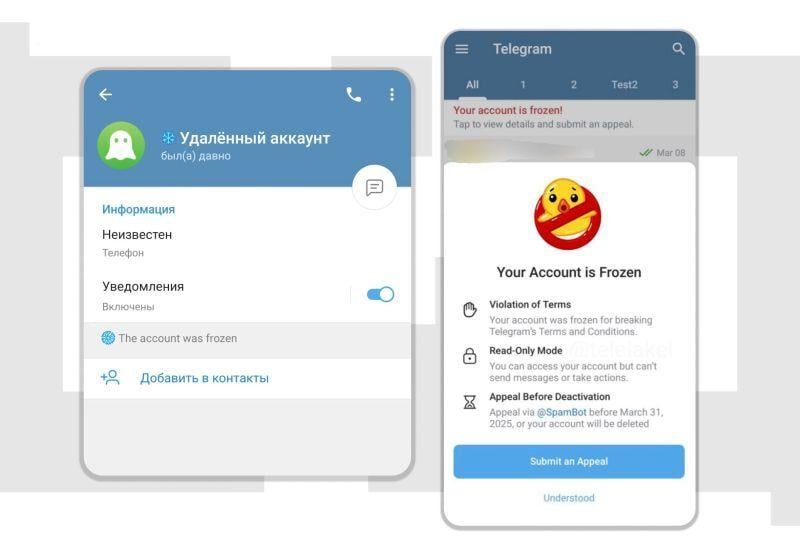
Officially, Telegram acknowledges only the obvious factors: accounts are restricted due to complaints, messaging strangers is a risky zone, and new profiles may receive limits right after registration.
In practice, however, multiple accounts that constantly log in from the exact same IP address are trivially linked within Telegram's systems. While this is not an official platform statement, it is already established common knowledge among those who burn through hundreds of accounts daily.
Furthermore, a single ban triggers a cascade effect. This means that if one of your accounts gets sanctioned, neighboring accounts start picking up restrictions noticeably faster. This is a widely observed phenomenon.
Telegram is under no obligation to explain its anti-spam logic. Yet, operators of large networks established a rule long ago: never log into Account A using the proxy of Account B—not even once. This cross-contamination permanently links the two profiles in Telegram's backend. No one has officially confirmed this, but within the market, it is already an axiom.
IP Remains the Main Signal, But It Is No Longer the Only One
An IP address is the cheapest and most reliable way for Telegram to tie your accounts together. Dozens of logins from a single address, dozens of registrations, identical geolocations—all of these act as red flags for the automated system.
It is especially dangerous when you persistently use the same proxies for different accounts. The system recognizes a pattern: these profiles always come online together, visit the exact same groups, and perform identical actions. From a machine learning perspective, this is a nearly 100% interconnected infrastructure.
However, throughout 2025–2026, the professional community began noticing that Telegram is looking much deeper.
The messenger utilizes a multi-layered detection system that goes far beyond IP addresses. The list now includes browser fingerprints (WebGL, Canvas, Audio Context, fonts), time zones, and even behavioral patterns. This closely mirrors the technologies long utilized by Facebook, Google, and TikTok.
Behavior Is Becoming More Important Than Infrastructure
This is the defining trend of the past two years.
Telegram no longer cares as much about where you logged in from if your actions betray a bot within the first few minutes. Ban analysis shows that the algorithm flags accounts that immediately dive into high-volume activity: identical messages, sudden group invites, mass direct messaging, and rapid action growth.
Crucially, the problem is not the sheer volume itself. The issue is how closely those actions resemble automation. If fifty accounts are registered around the same time, use similar IPs, join the same groups, and publish identical texts, the system does not even need to link them directly—a statistical anomaly is more than enough.

New accounts are an entirely different story. They face harsh limits during their first 7 to 14 days: fewer messages per hour and restrictions on joining groups. Telegram effectively demands an adaptation period. The market refers to this as warming up (progrev). Without it, you are not even beginning your work—you are simply feeding fresh meat to the anti-spam system.
What to Do About It
If Telegram truly evaluates the cluster of signals around you rather than individual accounts, the primary objective shifts. You no longer just need "mailing software." You need a management system for your entire Telegram infrastructure.
This is the critical turning point: without centralized control, you will inevitably generate the very signals that lead to bans. Dispersed accounts, manual status checks, forgotten sessions running on identical proxies, and a lack of proper warmup are all links in the same chain.
This exact stage is why professional teams migrate to platform solutions where the entire Telegram workflow is consolidated into a single window. Instead of a dozen separate profiles, you see the entire network as a whole: which ones are spam-blocked, which are frozen, and which are currently warming up. In short, you need a solution where you manage not each account individually, but the entire infrastructure as a single living organism.
This is precisely why experienced teams stopped searching for yet another mass-messaging tool a long time ago. When Telegram analyzes connections between accounts, workloads, behavior, and the infrastructure as a whole, the problem can no longer be solved by a standalone service or a fresh proxy.
You need a system that allows you to view the entire network as a unified mechanism.
Telegram Soft Expert was built specifically for this challenge. The platform integrates account registration, warmup, proxy management, restriction monitoring, load balancing, and analytics into a single interface. Instead of dozens of fragmented tools, you get a centralized command center for your entire Telegram infrastructure.
If a new account cannot be sent straight to work, the warmup module handles it. If you need to control registration quality and account preparation, the platform offers automated registration and parameter generation systems. If some accounts get restricted, statuses and verification tools let you quickly localize the issue before it spreads to the rest of the network. If IP cross-contamination risks arise, built-in proxy management tools help you detect such situations in advance.
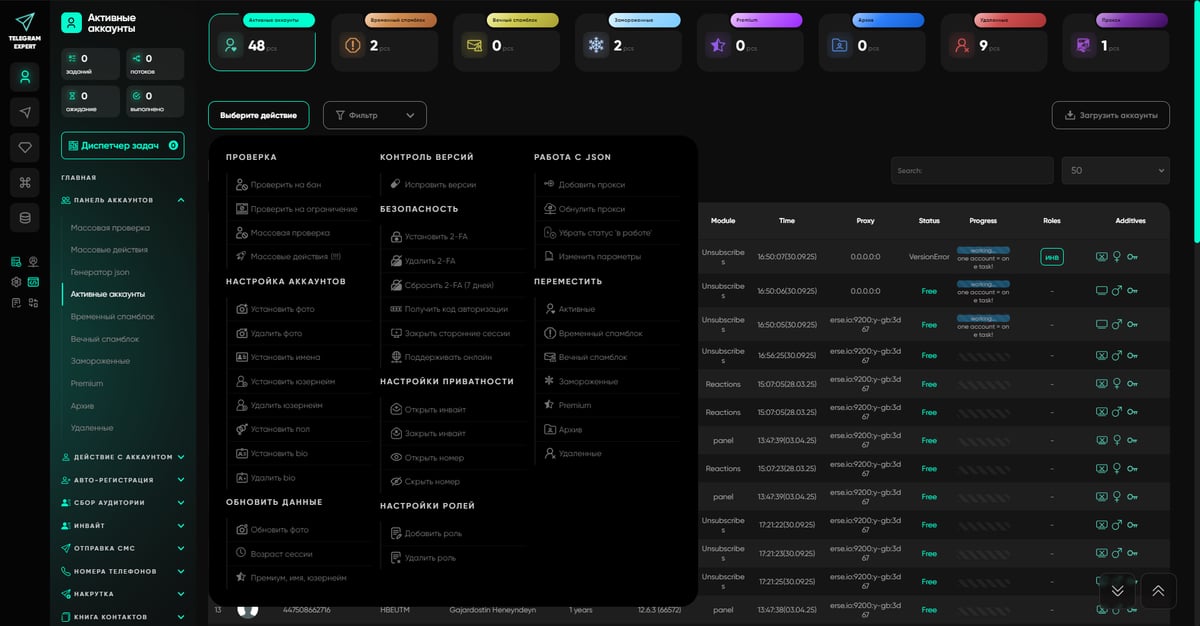
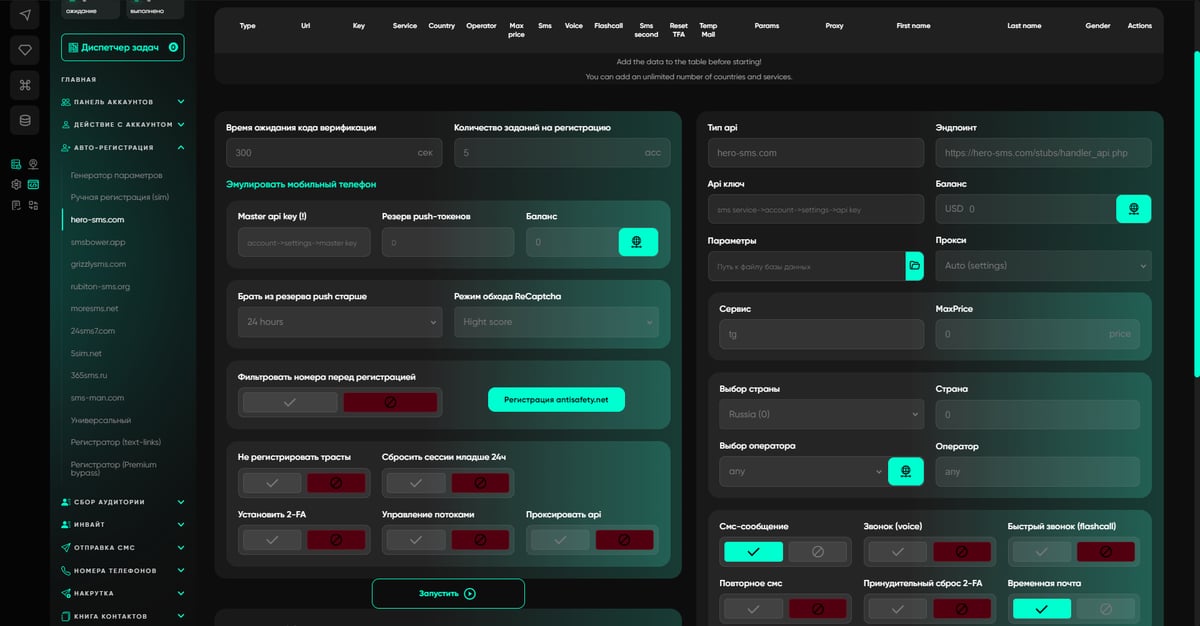
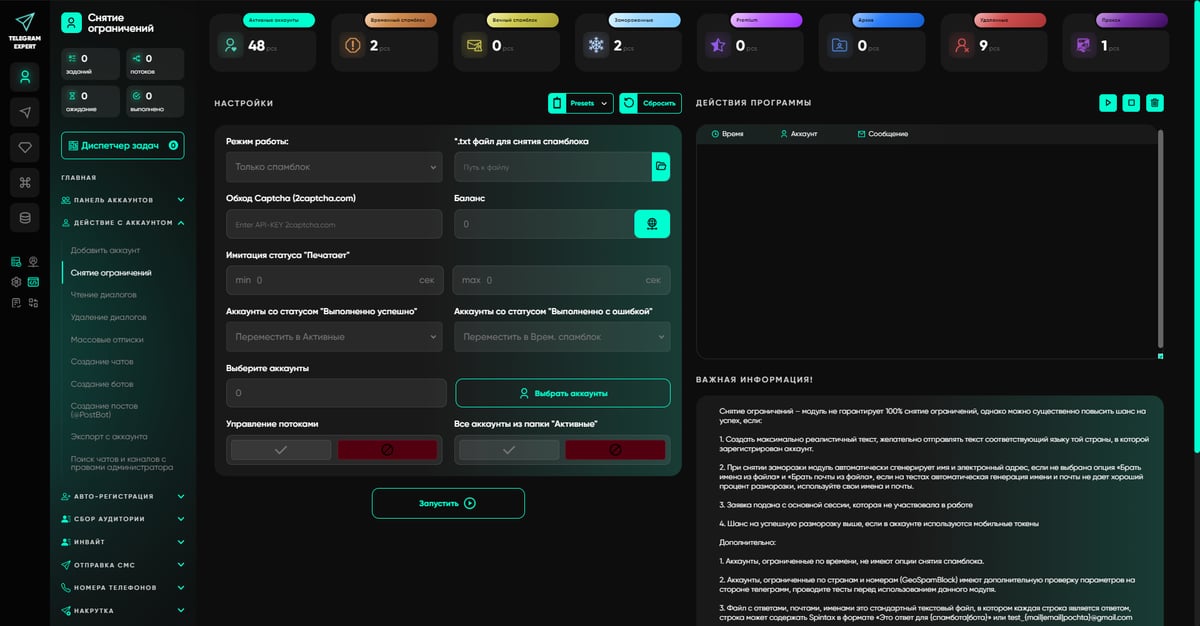
Importantly, this is not just about a few isolated features. Telegram Expert includes over 80 modules for various operational scenarios: from account and audience management to communication automation, analytics, and infrastructure maintenance. However, the platform's core value lies not in the sheer quantity of tools.
It lies in keeping all Telegram operations under control in one single place.
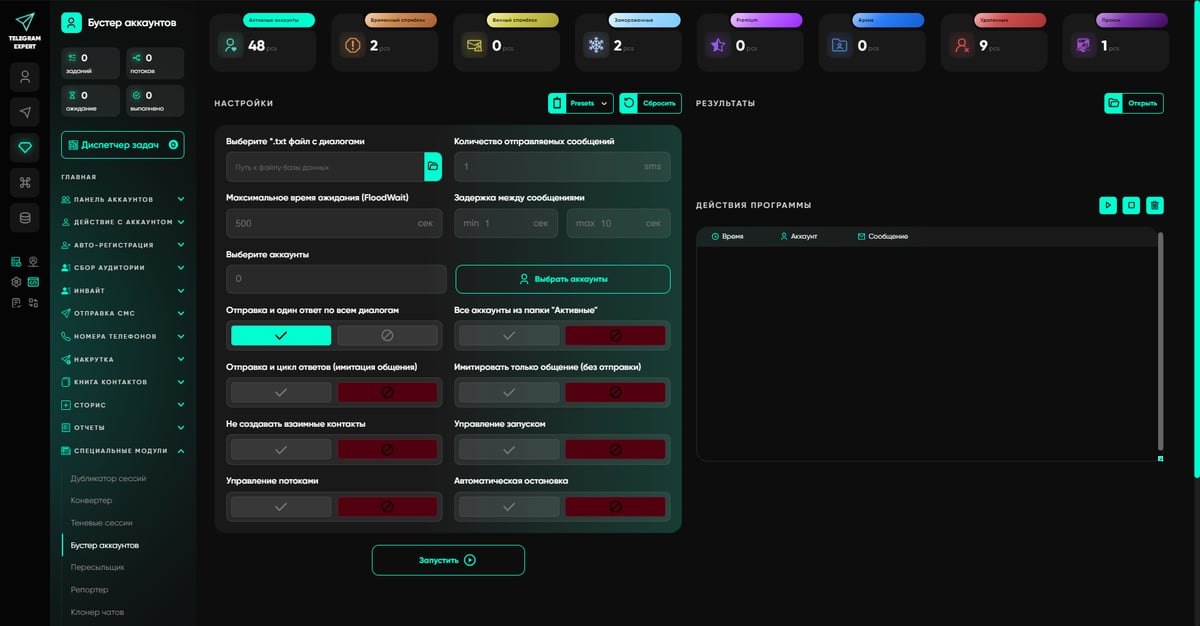
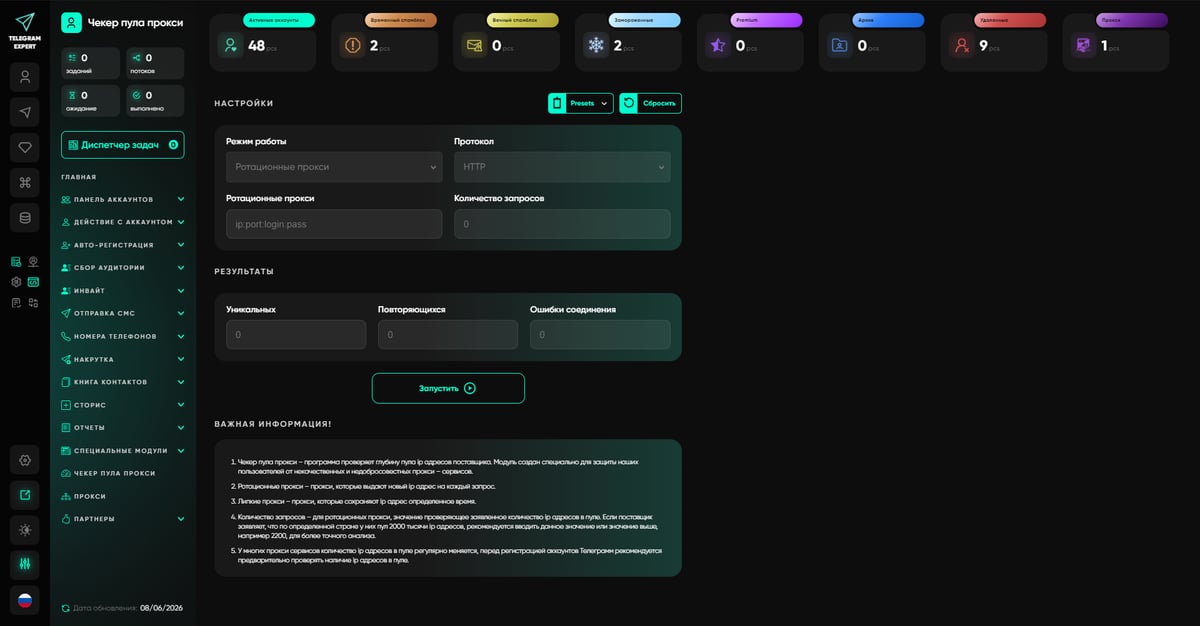
When you manage dozens or hundreds of accounts, a lack of control is precisely what causes most bans. Telegram Expert solves this problem at the systemic level rather than treating accounts one by one.
Conclusion
Over the past few years, Telegram has changed far more than many people realize.
While restrictions used to be easily bypassed by buying a new account or swapping a proxy, today the platform increasingly evaluates the cluster of signals surrounding a profile: its infrastructure, behavior, action history, and connections to other accounts.
Consequently, the primary task is no longer hunting for a replacement account, but managing the entire system as a cohesive whole.
This is where specialized solutions like Telegram Soft Expert become essential. The reason is not that they promise absolute immunity from bans—such guarantees do not exist—but rather that they allow you to control mission-critical processes: registration, warmup, load distribution, proxy handling, account statuses, and dozens of other factors that directly impact network resilience.
Ultimately, the question is no longer "how many accounts do you have?"
The real question is: how well do you manage the infrastructure they run on?
How well you manage that infrastructure now dictates how long your network will survive and how long Telegram will treat your accounts as regular users rather than components of an automated system.