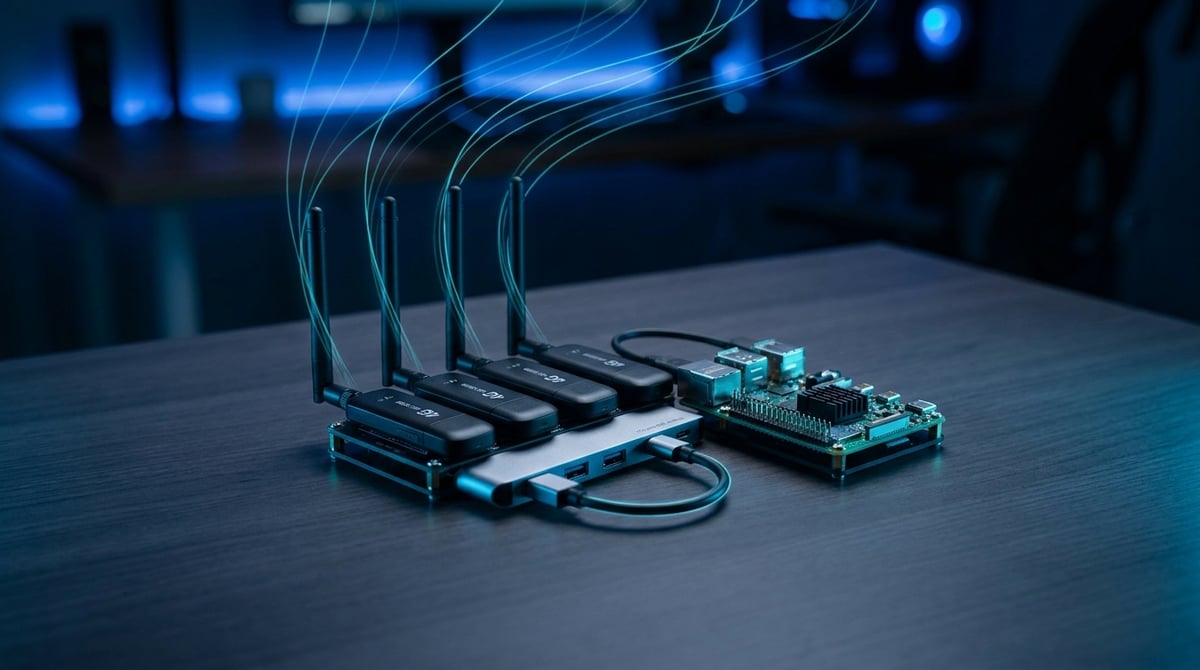
The query "DIY mobile proxies" consistently appears in searches: the logic seems solid — buy a modem, insert a SIM card, set up 3proxy, and get your mobile IP without a subscription. In practice, a home-built farm runs into not the complexity of setup, but four issues that are not mentioned in the old guides from 2019–2023: operator limits on sharing, modem revisions, network migration to IPv6, and how anti-fraud today looks beyond just the IP. We will break down the assembly step by step and honestly assess where it pays off and where it does not.
Who Really Needs a DIY Farm
A personal modem assembly is justified in three scenarios:
- One or two permanent mobile IPs "forever" — for example, for personal accounts that you have maintained for years and do not want to change networks.
- Working with a local operator that is not included in provider pools: a specific region, a specific ASN, a specific network.
- Full control over logs and traffic — when it is crucial that data does not pass through a third party.
In all other cases — which involve scaling, dozens of parallel sessions, different countries and geos — DIY falls short compared to a rented pool in terms of cost and administration time. Below will be the specific arithmetic.
What You Will Need: Hardware and Software
The minimum working kit for 4–8 channels looks like this:
- 4G/LTE USB modems with HiLink firmware — the classic choice is Huawei E3372h. An important nuance for 2026: the E3372h-320 revision lacks the standard unlocking and TTL fixing capabilities, which were available in the older 153 revision. Retail prices for the 320 model vary significantly in stores — approximately from 4,000 to 6,300 ₽ each. An alternative is consumer modems like the Alcatel IK4 family, which, according to an Infrawatch investigation, are widely used by commercial farms.
- USB hub with external power, preferably with individual port shutdown — the motherboard cannot power 8 modems, and port shutdown is useful for hard restarting a frozen modem.
- Host: Raspberry Pi 4 or any mini-PC running Ubuntu Server. CPU requirements are minimal; the bottleneck is the USB bus and power supply.
- SIM cards with a plan that allows sharing (more on this below) — this is the most underrated expense.
- Software: 3proxy as a proxy server, ModemManager for managing modems in Linux, plus rotation scripts.
Step-by-Step Assembly
- Distribute the modems across subnets. The HiLink modem is set up as a network interface with the address 192.168.8.1 — and all modems by default have the same address. Each one needs to be assigned a unique subnet like 192.168.N.1 through the web interface; otherwise, the system will see a route conflict and only the first one will work.
- Check that the interfaces are up. In Linux, each modem will provide a separate network interface; ensure that external traffic is actually going through each one, not through the host's default gateway. This is a trap where "the proxy works," but it is using your home provider's IP.
- Set up source-based routing. Each modem needs its own routing table and policy-based routing rule. Without this, the kernel will send all outgoing traffic through one interface.
- Launch 3proxy. A separate port for each modem, binding the outgoing address to the specific modem's interface, mandatory authentication via username-password or IP. An open port without authentication will be discovered by scanners within hours, and your channel will start living its own life.
- Implement rotation. Two working methods: software reconnection through the modem's firmware API (HiLink allows control of the connection via HTTP) or switching the network mode between 3G/4G. For assemblies on Android phones, rotation is done via ADB — a script toggles airplane mode on and off.
- Secure the perimeter. Proxy access should only be allowed through a whitelist of IPs or a strong password, and the control panel should not be accessible from the internet. A home channel with an open proxy quickly turns into someone else's transit.
How Mobile IP Actually Changes
It is important to understand the mechanics here; otherwise, expectations will diverge from reality. Mobile operators keep thousands of subscribers behind a shared pool of public IPv4 addresses — this is CGNAT. Hence the main value of a mobile IP: a platform cannot ban such an address without simultaneously affecting live paying subscribers.
Changing the address involves a forced reconnection to the network, after which the operator assigns a different address from the regional pool. The April report by Infrawatch (published on April 21, 2026) describes how this works for commercial farms: the software programmatically toggles airplane mode for about three seconds. When manually switching on a phone, it usually takes 5–10 seconds.
What does not change:
- Physical geolocation. The modem remains where it is. Only the address changes — and it can come from a neighboring city within the same regional pool. A modem with a Russian SIM will never issue a British address; a SIM from that country is needed for another country.
- Your stack's fingerprint. Anti-fraud has long looked beyond the IP: TCP/IP fingerprint (TTL, window size, MSS), matching TLS ClientHello with an actual mobile browser, consistency between "device ↔ network," account attributes, and payment intersections. A mobile IP on a desktop stack is a noticeable mismatch.
Four Pitfalls That Break the Economics
1. Sharing Limit
This kills more DIY farms than any technical issue. Traffic in the modem or router is counted by the operator as sharing — and on unlimited plans, it is restricted. For MTS, on plans with unlimited traffic, you can share no more than 30 GB per month with other devices. A separate charge for sharing in Russia was abolished by the FAS back in September 2023 — but the abolition of the fee does not mean the abolition of limits, and it is precisely these limits that the farm runs into. The plan for the modem needs to be chosen carefully, and its terms should be read thoroughly, rather than relying on the word "unlimited" in advertising.
2. Modem Revisions and TTL
Instructions from five years ago were written for the Huawei E3372h-153, where unlocking and TTL fixing were available. The current 320 revision lacks these capabilities. When buying a "modem according to the guide," it is easy to end up with hardware that behaves differently than described in the instructions.
3. Migration to IPv6
Operator cores are transitioning to IPv6-only with 464XLAT translation. The practical consequence: IPv4 traffic still goes through the shared CGNAT and maintains "anonymity in the crowd," but with native IPv6, a device can receive a unique or nearly unique prefix — the dilution among thousands of subscribers no longer works. For sensitive sessions, it makes sense to force traffic over IPv4.
4. Legal and Reputational Background
Mobile farms have come under the scrutiny of regulators and researchers. The same Infrawatch report counted 87 instances of the ProxySmart panel in 17 countries and 94 farm locations, including 19 states in the USA; the software is sold to farm operators at the price of a SIM card. In September 2025, the U.S. Secret Service dismantled an operation with over 300 deployed SIM servers and 100,000 SIM cards. Having a farm of several modems for personal tasks is not the same as a commercial SIM farm, but the context is worth keeping in mind: the larger the assembly, the more careful both the operator and platforms will be. A similar story occurred in the residential market — we discussed it in the article about where IPs come from in residential networks.
Counting Money Honestly
The setup for 4 modems in initial expenses: modems — approximately 16,000–25,000 ₽, hub with power and mini-PC — another 8,000–15,000 ₽. Then monthly: 4 SIM cards with suitable plans. In total, several tens of thousands of rubles at the start plus subscription fees — for 4 channels in one city, with one or two operators.
Add to this what is not visible in the estimate: setup, freezing modems, overheating hubs, blocks when exceeding sharing limits, lack of backup when the channel drops, and a complete absence of geo-diversity. A farm is not "set it and forget it"; it is a small infrastructure requiring constant maintenance.
The fork is simple. If you need one or two stable mobile IPs in your city for years — DIY makes sense. If you need dozens of sessions, different operators, different countries, and predictable availability — rented mobile proxies are cheaper within a few months because you do not pay for idle hardware and your time. And if the task does not specifically require a cellular network — most parsing and website interactions can be handled by residential proxies, which are significantly cheaper than mobile ones per gigabyte.
What to Do Before Buying Modems
- Clarify with the operator the exact sharing limit on the chosen plan — in gigabytes, not in marketing terms.
- Check that you are buying the correct modem revision, not just "the same model."
- Estimate the actual monthly traffic volume: if it is small, renting is almost certainly more cost-effective.
- Preemptively address fingerprinting issues — a mobile IP alone guarantees nothing if the client's stack looks like a desktop script.
If after this you want to experiment with home infrastructure without cellular modems, it is easier to start with a simpler setup — we described it in our guide on home proxy server on Raspberry Pi.
Conclusion
Building mobile proxies yourself is not a myth: the "HiLink modem + 3proxy + rotation script" scheme works in 2026. The environment has changed: sharing limits have become the main constraint, modem revisions no longer match old instructions, operators' transition to IPv6 alters the very nature of "mobile trust," and anti-fraud has long been looking at the combination of network plus device, not just a single address. Build a farm when you need a specific operator and full control. When you need scale, geo, and stability — do the math, and almost always the calculation will favor renting.